Investment Casting v Machining: Which is Best for Your Project?
Welcome back to another foundry basics blog, where we get you up to speed on a topic in metalworking in under five minutes of reading time. Today’s topic? Investment Casting v. Machining, and when to choose one over the other for your metal parts.
Both machining and casting have been used for a long time, so choosing the right process isn’t really about which method is "better", but rather about which method is better for the nuances of your specific project, including part geometry, material selection, production volume, budget, and beyond.
We’ll get into all of that below, but as always, here’s our TL;DR (Too Long Didn’t Read).
Machining is a great choice for low to medium-volume projects, those that require very precise parts (e.g., precision within ±0.001"), and projects that require quick turnaround times. Machining also offers great material flexibility, allowing engineers to work in hundreds of metals that may be very difficult to cast.
Investment Casting is a great choice for medium to large-volume projects or ongoing manufacturing needs. It offers consistency and cost savings in bulk production. Investment casting is also the go-to choice for parts with complex geometries, such as internal cavities, textured surfaces, or thin walls, that may be impossible or difficult to consistently produce via machining.
With that out of the way, let’s get into it!
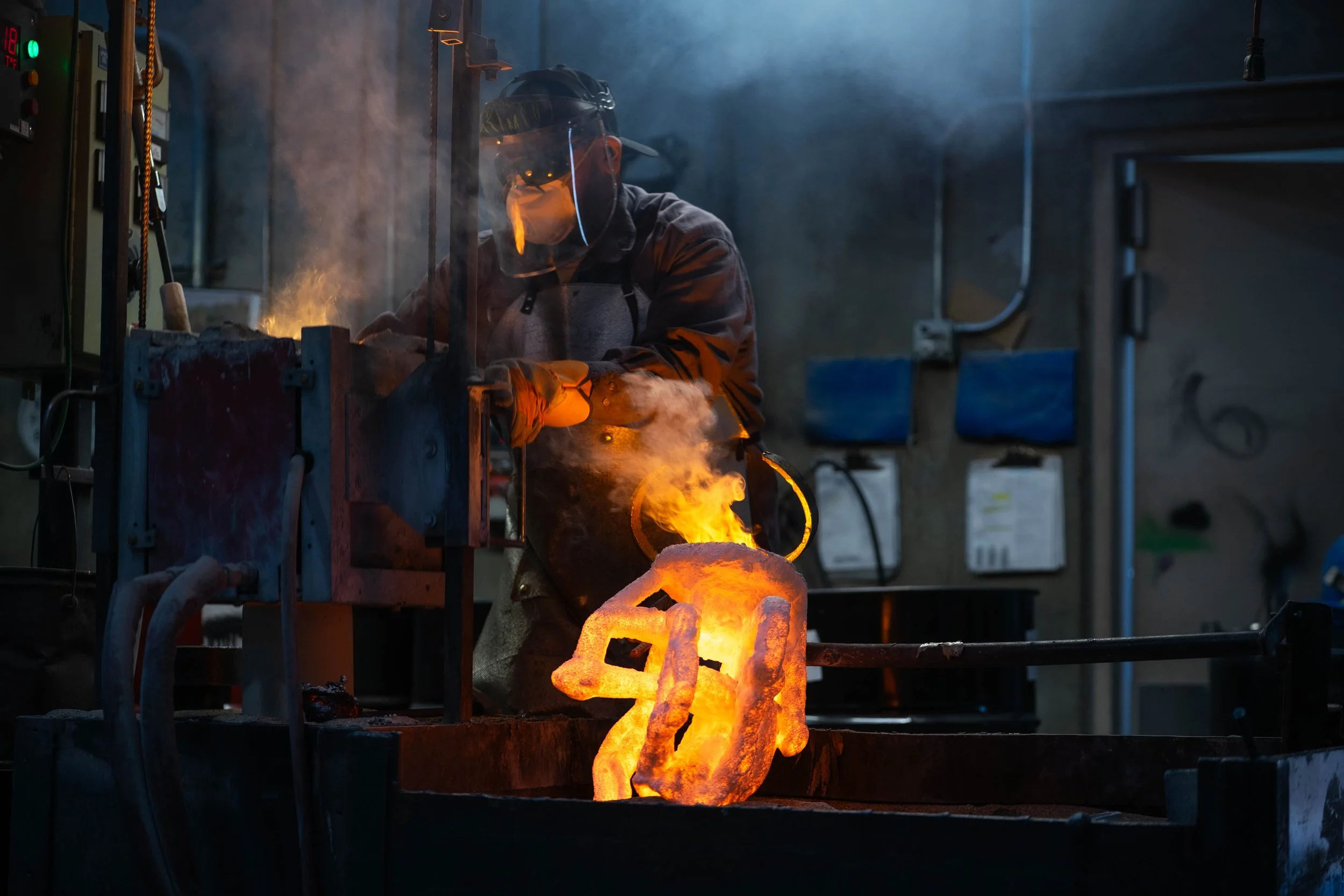
Investment Casting uses wax patterns and ceramic shells to form 1:1 molds for metal forming. In this image, you can see a ceramic mold recently filled with molten metal.
A Quick Look at Investment Casting
Covering the entire investment casting process is a bit beyond the scope of this article, but here’s a quick refresher:
Investment casting uses wax patterns and ceramic molds to create a 1:1 replica of your part. These patterns are highly detailed, allowing for complex shapes, fine surface finishes, and capturing every detail of your soon-to-be part. With these molds in place, the foundry team will pour molten metal into the ceramic to create your metal parts.
Advantages of Investment Casting
1) Parts Are Near Net Shape:
In machining, you start with a solid block of metal and cut material away until the part remains. As a result, you are paying for metal that ends up as floor scrap.
The Benefit: Investment casting produces a part that is nearly identical to the final dimensions right out of the mold. Because we pour liquid metal into a precise ceramic cavity, we only use the material required for the part itself.
The Result: For high-cost alloys, such as nickel-aluminum bronze, this drastically reduces waste ratios, reducing your footprint and your budget.
2) Complex Geometries:
Traditional machining is limited by the reach of a physical cutting tool. If a part has features such as internal curved channels or deep undercuts, a CNC machine might require multiple setups or even cutting the part in half and welding it back together.
The Benefit: Since the ceramic shell is built around a wax pattern, it can reach spaces a drill bit cannot. We can create internal cooling veins, thin-walled housings, and complex features in a single pour.
The Result: Achieve complex geometries that are very difficult or impossible to achieve through machining alone.
3) Cost and Time Savings with Bulk Production:
While traditional investment casting requires tooling that can be expensive and time-consuming up front, once tooling is in place, investment casting can save you significant time and money in bulk production.
Benefit One: Once the tooling is created, the cost per part is significantly lower than machining. Machining 1,000 parts requires 1,000 individual blocks of time on a spindle. Casting 1,000 parts leverages a repeatable, high-volume process.
Benefit Two: The casting process allows for multiple parts to be cast in a single operation, utilizing part “trees” (see photo below). For bulk production, the consistency and speed of investment casting really stand out.
The Result: For mid-to-high volume production runs, the foundry is almost always the more cost-effective choice.

Multiple wax patterns of parts (light green) are being attached to a gate and tree system (dark green). This enables foundry workers to pour multiple parts in one go.
A Quick Look at Machining
Much like casting, there’s a lot to machining that is beyond the scope of this article; however, here is a quick refresher:
Machining is a subtractive process. You start with a standardized piece of raw metal and use high-speed cutting tools to carve away everything that won’t be in your part. You can compare it to whittling with a pocket knife or sculpting a statue out of a block of marble.
Advantages of Machining
1) Unmatched Dimensional Accuracy
While investment casting is precise, machining is in a league of its own when it comes to "tight" tolerances.
The Benefit: CNC (Computer Numerical Control) machines can consistently hold tolerances within ±0.001" to ±0.0005" (and even tighter for specialized work).
The Result: If your part has a critical fit, such as a high-pressure seal or needing to interface perfectly with another assembly, machining is essential.
2) Speed for Low Volumes and Prototypes
The biggest hurdle for casting is the lead time required to design and build the tooling. Machining skips this phase entirely.
The Benefit: There is no "tooling" to build. Once the CAD model is programmed into the machine, the machinist can start spinning immediately.
The Result: For prototypes, one-offs, or small to medium production runs, machining is significantly faster and more cost-effective because you aren't paying for a mold you might only use once.
3) Material Flexibility:
While modern foundries can cast a wide range of alloys, machining offers access to nearly limitless material options, including metals, plastics, wood, and more. Machining may also give you easier access to materials that are traditionally difficult to cast consistently.
The Benefit: Machining uses "wrought" materials, metals that have already been rolled, drawn, or forged into standard bars, plates, and rods. Because these materials don't need to be melted and poured, you can easily use specialized alloys that might be difficult to cast consistently.
The Result: If your project requires a very specific grade of aluminum or a high-strength plastic that would melt or burn in a furnace, machining is a great choice. It allows you to select from a massive catalog of off-the-shelf metal shapes that are ready to be cut immediately.
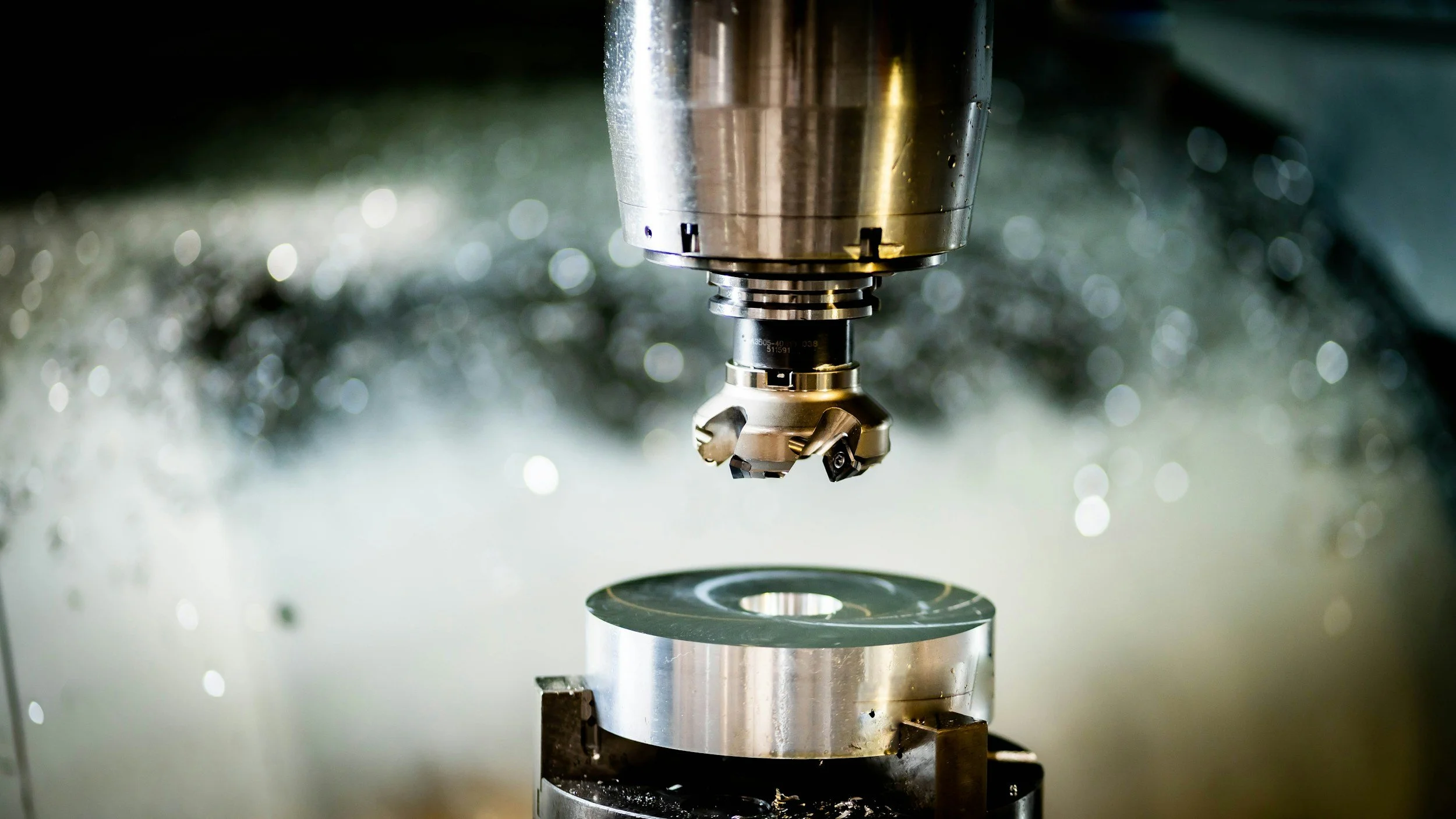
Machining uses automated cutting tools to form metal parts.
Why Not Use Both?
We’re glad you asked!
In many cases, the best and most cost-effective solution isn’t an "either/or" choice. High-performance parts often use both methods to maximize cost savings, efficiency, and precision.
Cast for Shape: Use investment casting to get the part near completion. This captures all the complex internal features and near-net shape benefits, while also drastically reducing expensive material waste.
Machine for Fit: Next, use machining to finish the most critical areas, like adding threads to a hole or shaving down a piece for a perfect fit.
The Result: You get the high-volume cost savings of a foundry with the extreme precision of a machine shop.
Conclusion
Choosing between investment casting and machining ultimately comes down to the needs of your project, but for many projects, engineers use both methods! Here’s a quick recap of what we covered today:
Choose Investment Casting for cost and time savings when producing in bulk or for ongoing projects. Investment casting is also the go-to method for projects with complex geometries (thin walls, internal cavities, etc.).
Choose Machining for quick turnaround, small to medium volume projects or rapid prototyping. Machining is also the go-to choice if your project requires extremely tight tolerances that only a CNC tool can hit.
Whatever the scope of your project, IPC Foundry Group can help you get it done. Our two US-based facilities offer everything you need to bring your project to market, including investment casting, machining, and a full suite of finishing services such as heat treating, NDT, plating, and more. With over 45 years of experience and a team that consistently goes the extra mile for our customers, IPC is a production partner you can count on for years to come.