
What is Flow Analysis in Investment Casting?
Welcome back to another Foundry Basics blog, where we tackle FAQs, Community Questions, the investment casting process, and the ins and outs of things within our industry. Today's topic? Flow Analysis and how it benefits not only the production team but also customers. Let's get into it!
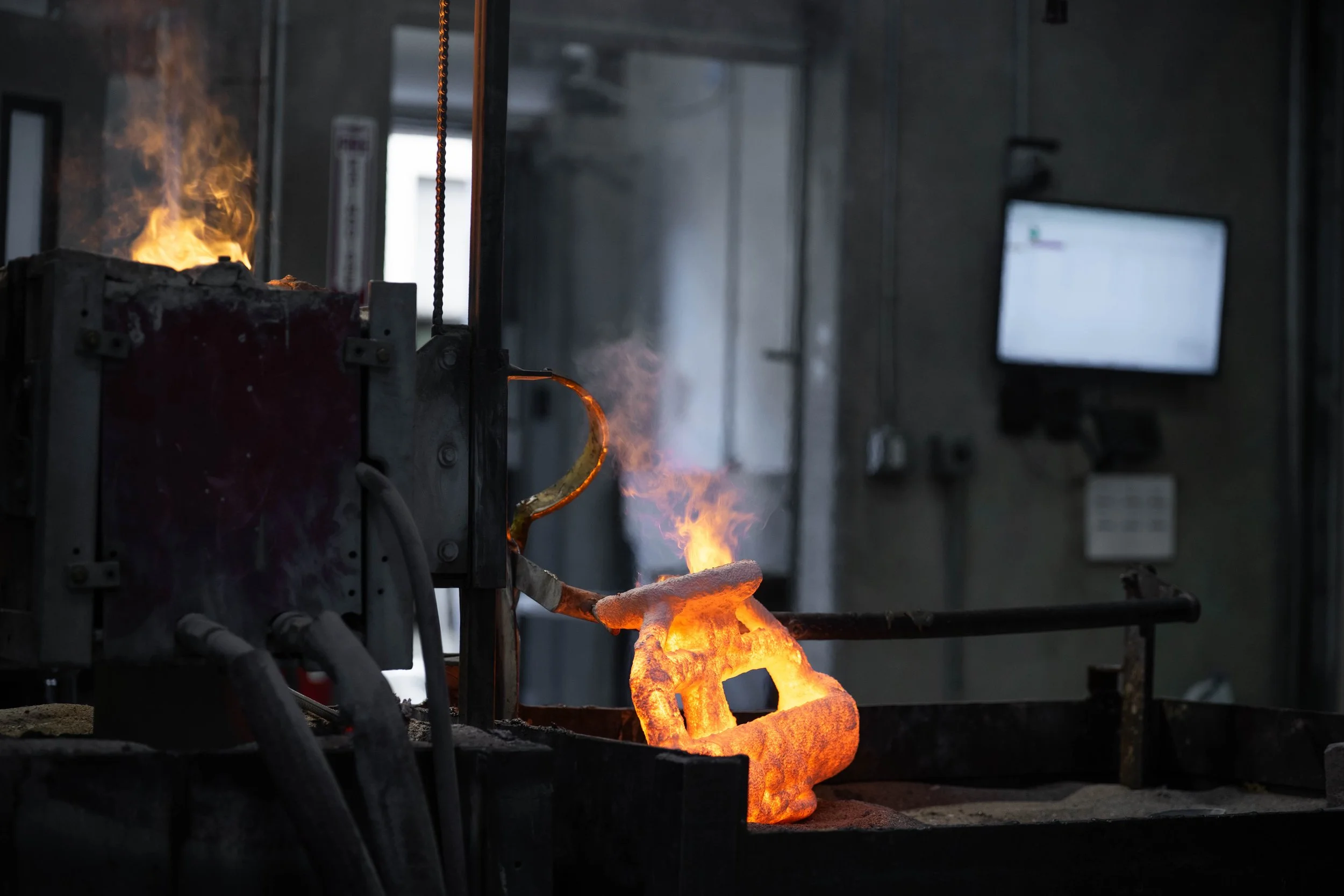
Flow Analysis helps provide greater consistency in investment casting.
What is Flow Analysis?
Simply put, flow analysis is a type of predictive modeling that uses computer software to simulate how molten metal behaves as it is poured into a mold for a part. With this analysis, foundry engineers can make informed decisions about gating, part clustering, pouring, and other steps of the casting process to improve consistency, speed, and quality.
If you're familiar with the investment casting process, this may make perfect sense, but if you're new to the process or need a refresher, it's beneficial to follow an analogy.
An Analogy: MapQuest
Many of you may recall planning road trips before the advent of smartphones and using a service like MapQuest. For the uninitiated, MapQuest launched in 1996 and was one of the very first online map services available to the public. Here's how it worked: you would hop onto the website and type your starting point and your destination, then Mapquest would create a list of directions to get you from point A to point B. You’d then print out, or write down the directions, and hit the road.
The directions might’ve look a little something like this:
1) Go 1/4 from your address until you reach Main Street. Turn right onto Main Street.
2) Follow Main Street until you reach the I-10 East at Overland Boulevard
3) Proceed on the I-10 East for 70 Miles. Exit at the 111 freeway Southbound.
4) and so on...
MapQuest was awesome, and made finding your way in a new city or to a new place much easier than packing around road maps or just hopping in your car and going for it. Much like flow analysis, it allowed you to look at what to expect from the road in front of you and plan out your trip (stops for food, gas/pee breaks, etc.) before ever getting in the car.
It wasn't always perfect; sometimes you'd run into a road closure or incorrect information, and you would be on your own and have to wing it until you could find something familiar and continue on your journey. But it saved many people (myself included) tons of headaches and time on the road.

How Flow Analysis Helps Foundry Engineers
With our analogy in mind, Flow Analysis lets the engineering and production teams look ahead in the process and make informed decisions that will lead to more consistent high-quality parts, greater capacity through optimized production, less time wasted during sample prep, and refined & tested gating systems. Let's unpack that a little bit more.
What Are Gates and Trees in Investment Casting?
Before metal is ever poured, foundry workers prepare wax patterns, which are 1:1 scale replicas of the part(s) used to create molds for metal pouring. To further optimize production, most wax patterns can be combined into what are called "trees" of parts (see photo below). Each wax pattern will be connected to a central channel or trunk (called a sprue) that allows the foundry team to pour multiple parts in a single action, significantly speeding up the production timeline.

A foundry worker attaching gates to a central sprue (both seen in dark green) and wax patterns, the 1:1 part replicas (seen in lighter green).
Each pattern on a tree is connected by what is called a gate or gates that establish the point where molten metal will eventually flow into the mold and create the castings. This flow through the gates and sprues is exactly what flow analysis is trying to model and predict!
How Does Good Gating Help?
Time for some more analogies. We've all been on the wrong end of super glue drying too quickly; maybe it binds and dries to one piece and not the other, or gets all over your fingers, giving you that weird scaly feeling until you're able to get it off. Similarly, maybe you've painted a wall and watched in frustration as paint lines stream down the wall, ruining your coat.
When the flow of molten metal is off, it creates errors in the final product. These could be air pockets, porosity points, rough surface finishes, outright part failures, or other issues. Optimized gating helps engineering and production teams significantly reduce or altogether eliminate these issues and get your parts across the finish line up to spec and up to standard.
How Flow Analysis Helps Investment Casting Customers
Flow analysis is a massive benefit to customers and can benefit them in four major ways: cost, speed, consistency, and quality. Let's take a quick look at each.
1) Cost Savings:
While flow analysis does require upfront spending, it markedly reduces hidden or unexpected costs down the line.
With flow analysis, teams can make more informed decisions in creating tooling for wax patterns and gating systems, saving time and money on the creation of tooling.
Engineers can identify flow issues early and prevent material and time waste during the sampling stage.
Flow analysis can help identify turbulent zones, porosity points, or other potential part failure points, preventing material waste, part failure, or even worse, expensive recalls.
2) Time Savings:
Just like our MapQuest example, you can spend less time searching for the right method and get it right the first time.
Significantly reduce testing times and hit the ground running with parts that may be production-ready on the very first pour.
With accurate flow analysis, you can get a much more rigid expected timeline for delivery than with trial-and-error sampling.
Optimize gating to produce as many high-quality parts, in one operation, as possible.
3) Consistency:
Flow analysis enables us to reliably predict hot spots, turbulence zones, porosity, air pockets, or any possible failure points; ultimately allowing foundry workers to optimize gates, trees, tooling, and more to prevent defects.
Less waste & breakage
Consistent quality across your parts
4) Quality:
When used in conjunction with QA/QC systems, flow analysis allows foundries to quickly turn around exceptional quality parts, time after time.
Quality production cycles from start to finish.
Add flow analysis paperwork to your documentation to stay up to industry standards and compliance, as well as your business's own quality benchmarks.
Inspect flow analysis yourself during the approval stage to see a foundry's plan of attack for your components.
Does IPC Foundry Group offer Flow Analysis?
Yes, IPC Foundry Group offers 3rd party flow analysis to optimize their production timeline and consistently offer their customers exceptional quality castings.
Wrapping Up: Take the Guesswork out of Your Casting Project
To summarize, flow analysis helps production teams bridge the gap from guesswork to informed decision making. By creating a digital twin of the casting process, we identify and solve potential defects like porosity or air traps before a single drop of metal is poured.
For the customer, this means lower costs, shorter lead times, and total confidence in the structural integrity of the final parts.
If you’d like to learn more about flow analysis or the investment casting process, or see how IPC Foundry Group can help you save time, money, and headaches on your next manufacturing project, contact our team today!
IPC Foundry Group is home to two, domestic foundries and is CMMC-2 compliant and ISO 9001 certified. We also have over 45 years of experience providing quality investment casting services for customers in hundreds of unique industries.